
The Heybike Saturn might be one of the most interesting budget moped-style eBikes of the year, and it pulls that off with a simple trick: it hands you a ton of battery, a ton of power, full suspension, hydraulic brakes, fat tires, and a big comfy frame for a price that feels almost weirdly low.
The single-battery Saturn starts at $999 with one 18.4Ah pack and a claimed 30 to 50 miles of range. The dual-battery version we tested comes in at $1,299 with two 18.4Ah batteries — 36.8Ah combined — and a much bigger 55 to 90 mile claimed window.
After putting the dual-battery setup through our testing, the headline is easy: 50+ miles of real-world range is genuinely doable, and not just by babying it at low speed. You can rip on this thing in the higher modes and still clear 50+ miles. That makes the Saturn one of the strongest budget picks we have tested for riders who want a moped-style eBike that can actually go the distance.
At a glance
Heybike Saturn quick specs
The short version
Pros & cons
- 50+ miles of real-world range (dual battery)
- Huge value: full suspension, hydraulics, fat tires
- Strong 1000W / 1800W peak, 95 Nm motor
- Comfortable, planted moped-style ride
- 330 lb payload — great for heavier riders
- Heavy: 103–115 lb, awkward to lift or haul
- Moped feel, not a natural pedaling bike
- Needs extra braking room for the weight + speed
RiderGuide testing · 01
Real-world range
The Saturn is not just “long range for the price.” The dual-battery version is genuinely a long-range eBike if you ride it efficiently.
With the dual 18.4Ah setup, 50+ miles is easy even at medium-to-high speeds. We hit 51.5 miles riding in the top mode at high speeds and doing hill tests — that is the worst-case scenario, and it still cleared 50.
Heybike claims up to 90 miles for the dual-battery model. That may be possible under ideal conditions — lighter rider, low assist, flat terrain, slow speeds — but for normal riders on a heavy moped-style fat-tire bike, think of it as “50 miles comfortably, way more if you ride smart.”
A lot of budget eBikes are fun for the first 10 miles, then the battery anxiety creeps in. The Saturn is different. It has enough battery to go for a long cruise, run errands, commute, and take the scenic route without babying the percentage the whole time.
RiderGuide testing · 02
Speed & power
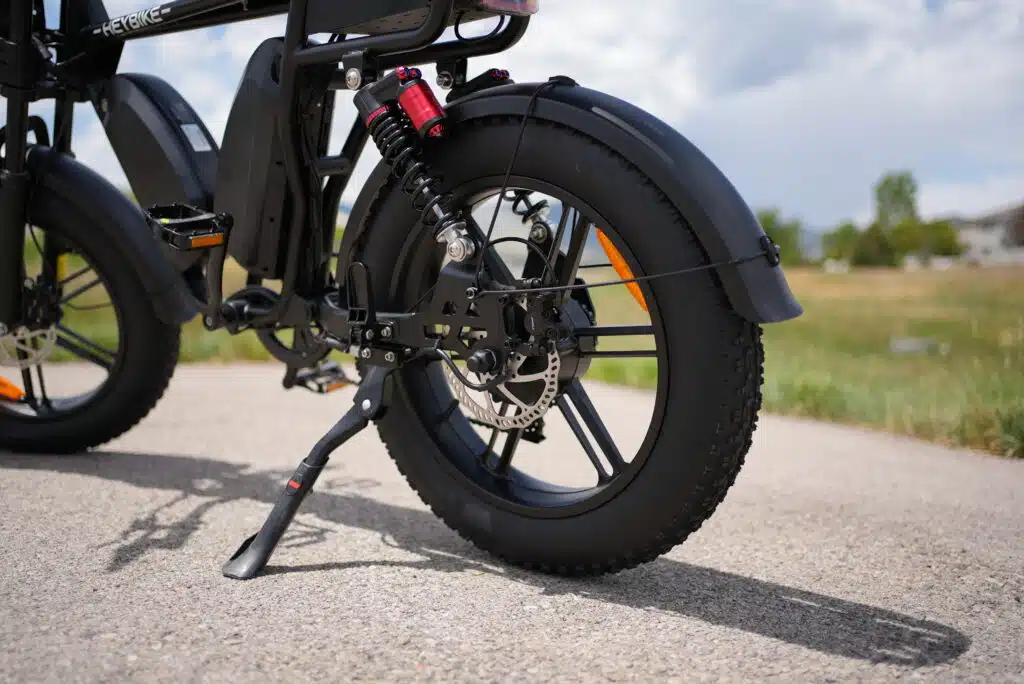
The Saturn has a 1000W hub motor with 1800W peak power and 95 Nm of torque. In plain English: it feels strong.
Acceleration is punchy, especially for a bike this heavy. It does not feel like a lightweight rocket, but it has that big, steady, confident push that makes moped-style eBikes so fun. It is happiest cruising fast and carrying momentum.
Out of the box it is a Class 3 eBike with a 28 mph top speed — plenty fast for most riders and most bike infrastructure. It can be unlocked up to 36 mph where legal, which completely changes the feel, but that comes with real responsibility. At those speeds this is no longer a casual bike-path cruiser.
Many bikes around $999 to $1,299 feel budget first and powerful second. The Saturn feels powerful first, then you remember how little it costs compared to a lot of other moped-style eBikes.
RiderGuide testing · 03
Comfort & ride quality
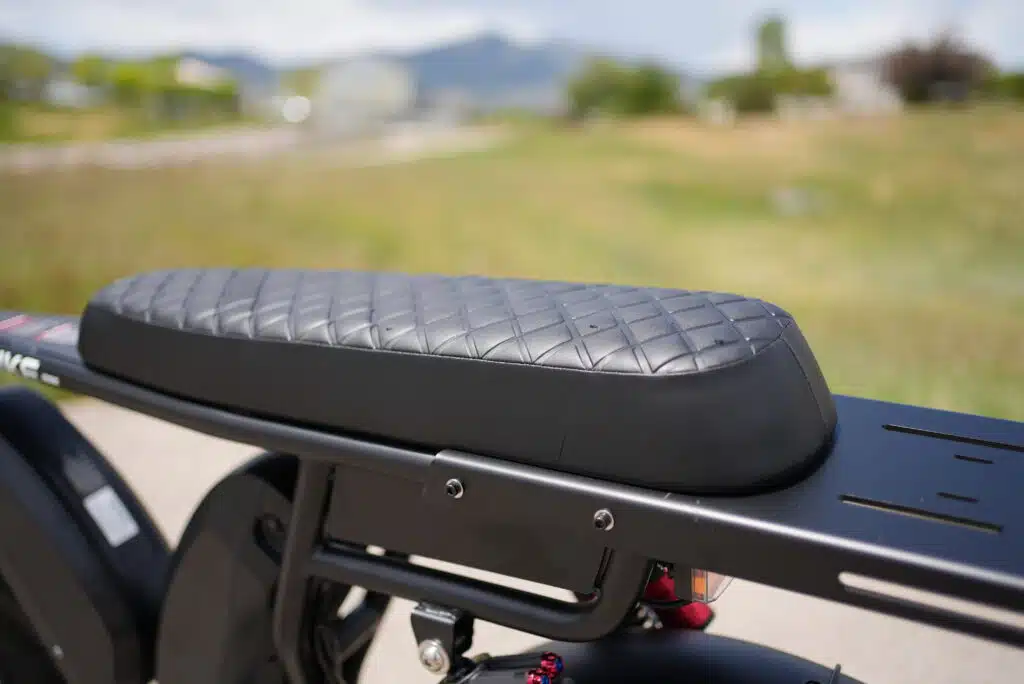
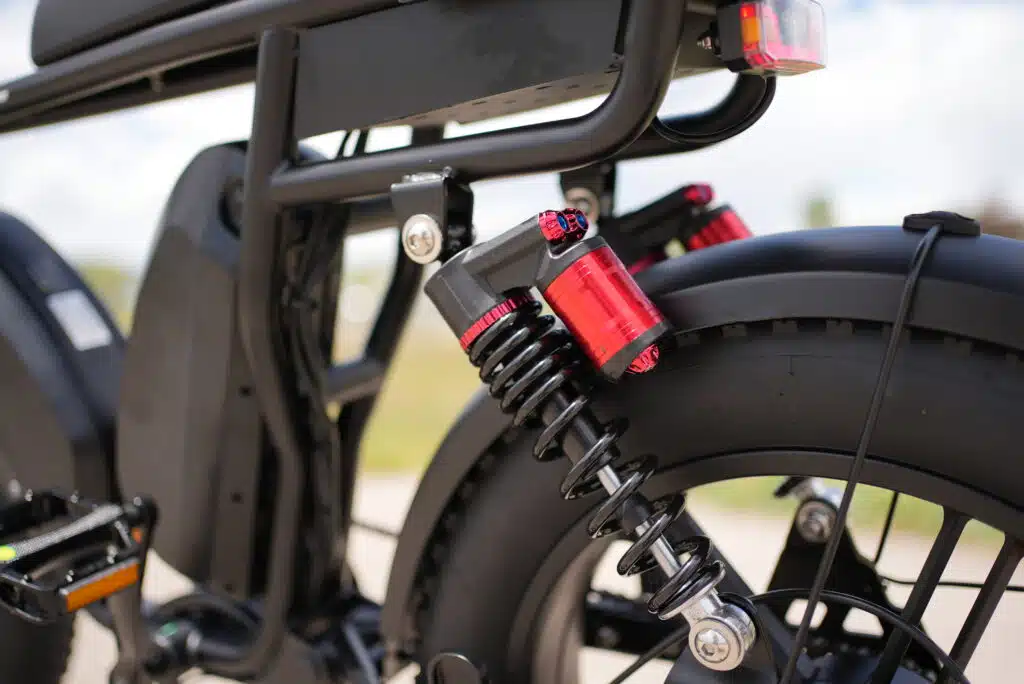
This is one of the Saturn’s best categories. The combination of a 140mm hydraulic front fork, dual spring rear suspension, and 20×4 fat tires gives it a very cushy ride. It is not a high-end mountain-bike setup, and no one should confuse it for one, but for city riding, commuting, gravel paths, rough pavement, and general cruising it works really well.
The front fork does the heavy lifting on bigger hits while the rear springs keep the back end from feeling harsh, and the fat tires add another layer of cushion. The result is a bike that feels planted and comfortable — which matters, because range only counts if the bike is comfortable enough to ride for a long time. The Saturn checks that box.
RiderGuide testing · 04
Braking
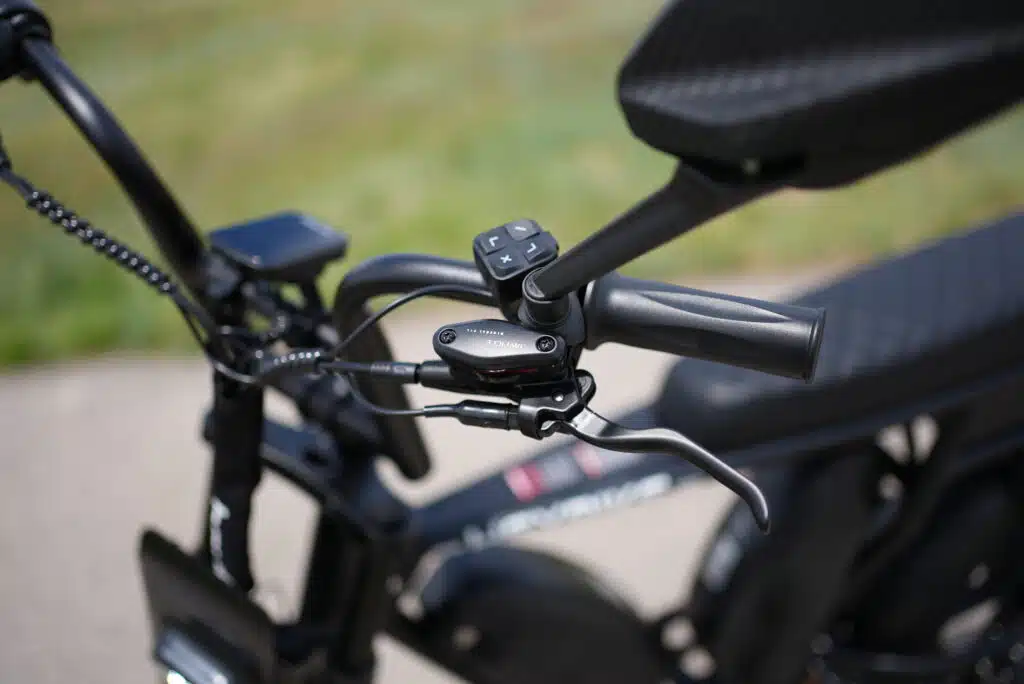
The Saturn uses 2-piston hydraulic disc brakes with 180mm rotors. For a budget moped-style fat-tire eBike, that is a solid setup. The lever feel is much better than mechanical brakes, and the hydraulic system makes the bike easier to control with less hand effort — which matters on a heavy bike in traffic, with cargo, or on descents.
That said, this is still a 103 to 115 lb eBike before you add a rider. Factor in the 330 lb payload capacity and you have to respect the weight. The brakes are good, but this is not a lightweight commuter that stops on a dime. The best way to ride the Saturn is to look ahead, brake early, and avoid panic stops.
RiderGuide testing · 05
Handling
The Saturn feels stable more than agile. The 20×4 tires give it a wide contact patch, and the long, heavy frame makes it feel planted at speed. It is easy to cruise on, easy to relax on, and easy to trust once you get used to the weight.
But if you are coming from a lighter commuter, the Saturn will feel big. Tight turns, bike racks, stairs, narrow apartment hallways, and crowded multi-use paths are not its natural habitat. This is a bike for riders who have space to store it and want a big comfortable machine for longer rides — not the pick for anyone who needs maximum maneuverability or portability.
RiderGuide testing · 06
Utility & payload
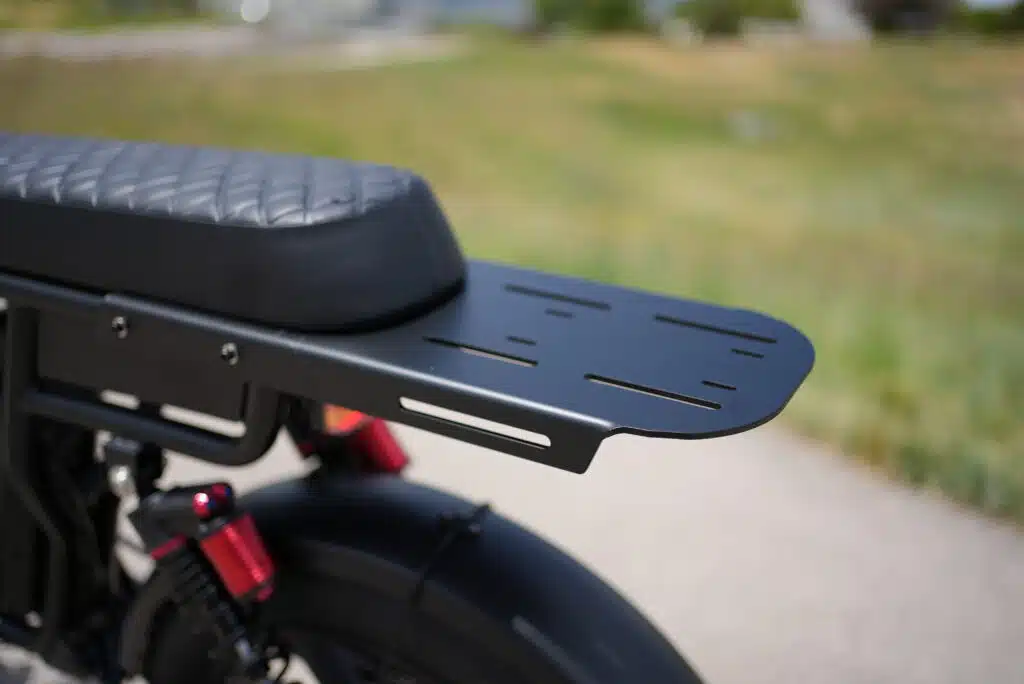
The Saturn has a 330 lb payload capacity, which makes sense for the kind of bike it is: built for larger riders, cargo, longer rides, and general utility.
For commuting, errands, and longer recreational rides, the Saturn has a lot of practical appeal. It is not a cargo-bike replacement, but it definitely feels like more than a basic commuter.
Which one to buy
Single vs dual battery
Best for shorter trips and the lowest entry price. You still get the same moped-style platform, full suspension, fat tires, hydraulic brakes, and strong motor.
Adds a lot more range without pushing into premium territory. It weighs 115 lb, so it is not for everyone — but if you want the Saturn for range, this is the one to buy.
The single-battery version is the budget moped-style eBike. The dual-battery version is the budget moped-style range king.
Decision guide
Who should buy the Saturn?
- A comfortable, powerful, long-range moped-style eBike under $2,000
- Ground-floor or garage storage for a big bike
- Throttle power and comfort over a natural pedaling feel
- 50+ miles without stressing over the battery
- A 330 lb payload rating — great for heavier riders
- Something lightweight, portable, or easy to carry upstairs
- A bike you lift into a vehicle regularly
- A refined, natural pedaling experience
- Maximum maneuverability in tight spaces
Final word
Heybike Saturn verdict
The Heybike Saturn is one of the easiest budget moped-style eBikes to understand: it is big, heavy, powerful, comfortable, and has a lot of range for the money.
The dual-battery version we tested is the standout. At $1,299, getting two 18.4Ah batteries, full suspension, hydraulic brakes, 20×4 fat tires, a 1000W motor, 1800W peak power, and a 330 lb payload rating is seriously impressive.
The weight is the main catch. At 115 lb, the dual-battery Saturn is not pretending to be convenient off the bike. But once you are riding, that same weight helps it feel stable, planted, and very moped-like. For riders who want maximum comfort, power, and real-world range per dollar, it makes a very strong case for the new budget moped-style range king.
Questions, answered
Frequently asked questions
How much does the Heybike Saturn cost?
What is the real-world range of the Heybike Saturn?
How fast is the Heybike Saturn?
How much does the Heybike Saturn weigh?
Should I get the single or dual battery Saturn?
Is the Heybike Saturn worth it?
Ride safe
The Heybike Saturn is fast, heavy, and powerful. Always wear a helmet, follow local eBike laws, ride in appropriate areas, and give yourself extra braking distance. Higher-speed riding should only be done where it is legal and safe.
Affiliate disclosure
This article may contain affiliate links. If you buy through links on RiderGuide, we may earn a commission at no extra cost to you. That helps support our independent testing and reviews, and our opinions remain our own.


