
Don't Expect a Lucid Pickup Truck Anytime Soon
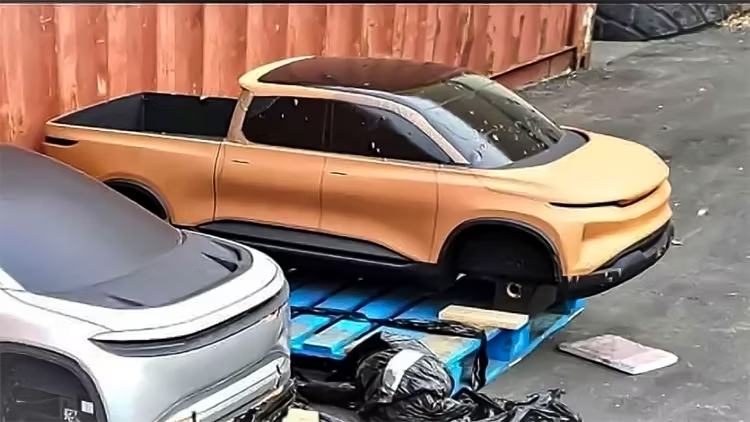
With their commitment to luxury and performance, it has seemed inevitable to many observers that a Lucid pickup truck would eventually arrive to compete with the Rivian R1T, Ford F-150 Lightning, or Tesla’s recently-released Cybertruck. A photo of a supposed clay model Lucid pickup truck that floated around the internet has not been confirmed by the company.
While it might seem like Lucid should go all-in on a truck to beat the competition, the reality is more complex. Lucid CEO Peter Rawlinson quashed rumors of a Lucid pickup truck at a recent event by saying, “I really think that it’s very tough to make an electric pickup truck work today. Not one that’s usable and cost-effective.”
Lucid has already had tremendous success in making energy-efficient vehicles that beat all of the competition in real-world range testing. The 2024 Lucid Air is the longest-range EV in production at the moment, with over 500 miles of tested range. Why wouldn’t they expand into the electric pickup truck space? In a few words, battery size and weight.
Unlike sedans, which have a relatively simple aerodynamic profile and use case, pickup trucks must balance power, payload capacity, and towing ability while maintaining performance and range.
“If you want a 300-mile-range pickup,” says Rawlinson, “which isn’t enough because the thing’s got to tow, you’re already into a pack size of 120 kilowatt-hours.” To fully meet the demands of modern pickup owners requires battery packs many times larger.
Why EV Pickup Trucks Are a Unique Challenge
Pickup trucks are a cherished staple of American automotive culture, revered for their versatility and ruggedness. Yet this popularity comes with expectations that are not easily met by electric vehicle technology. One of the core challenges in producing an electric pickup truck is the inherent weight of the battery technology.
A traditional pickup truck is built to haul heavy loads, but adding the substantial weight of batteries to that equation can lead to diminished performance in terms of payload and towing capacity. Electric motors may offer instant torque, but if the truck cannot support the weight necessary for hauling, it could fall short of consumer expectations.
Battery longevity is another key aspect. Pickup owners often use their vehicles for lengthy trips and heavy-duty applications, meaning they require a range that can meet their needs without frequent recharging stops.
EV makers like Lucid must find a way to combine high-capacity batteries with lightweight designs to maximize performance without compromising range. As Rawlinson put it, an EV pickup would require “a profound improvement in gravimetric energy density of cell chemistry” before it could be profitable under Lucid’s current efficiency model.
Unofficial real-time concepting of a Lucid truck
The Importance of Range and Performance in Electric Trucks
Range and performance are critical metrics for any electric truck aspiring to compete in a market dominated by established gasoline-powered trucks. A defining characteristic of traditional trucks is the ability to travel long distances and carry heavy loads without the need for constant stops at a fueling station. An electric truck must replicate these capabilities as a prerequisite for acceptance by potential buyers.
- Range: Customers need to trust that their truck can handle long journeys without depleting the battery.
- Performance: This includes acceleration, towing capacity, and handling on various terrains, all of which must meet or exceed that of conventional trucks.
- Charging Infrastructure: The availability and convenience of charging stations can significantly affect the perception of electric trucks.
For Lucid, this means investing in cutting-edge technology to enhance battery efficiency and performance, while also retaining their reputation for making luxurious rides that are miles ahead of their competition in terms of range.
A Lucid pickup truck, Rawlinson suggests, would only be a distraction from the profitability of Lucid Air sedans and their continued evolution toward greater efficiency, longer range, and more affordable pricing.
